

















The Cyber Resilience Act in order for your products

The EU regulation with cybersecurity requirements for hardware and software with digital elements. Tidal Control sets up the requirements for you, from secure design to vulnerability handling, keeps the technical documentation current and prepares you for the reporting duty.

  • All 93 CRA requirements pre-mapped
  • Reporting from 11 September 2026
  • Together with IEC 62443
  • Built in the EU
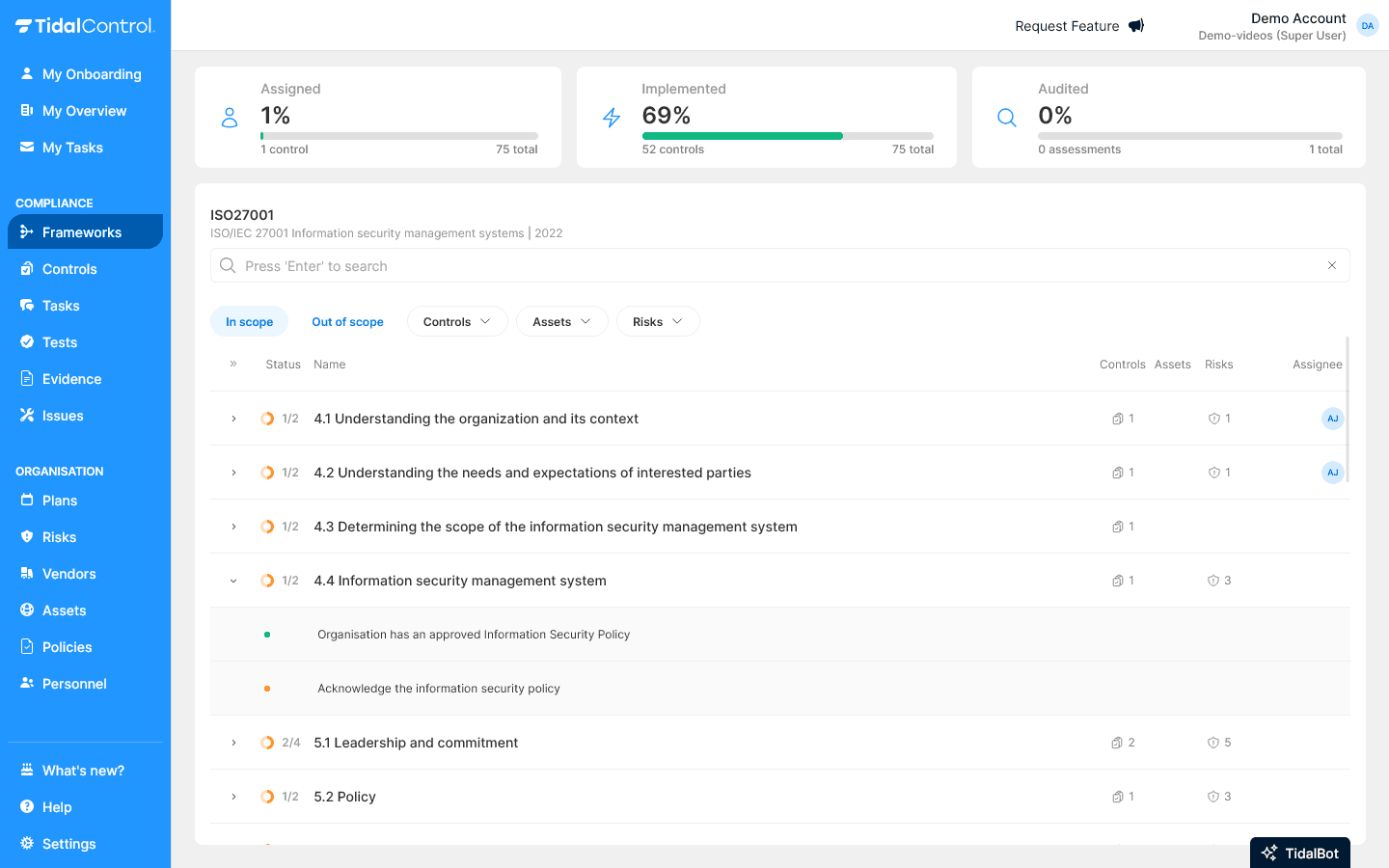
The CRA overview in Tidal Control with the status of requirements and evidence

These companies run their compliance on Tidal Control

  • LiveDrop logo
  • Datenna logo
  • CByte logo
  • Infradock logo
  • PoA logo
  • Floryn logo
  • ElasticScale logo
  • DebtCo logo
  • BrainStax logo
  • EnableNow logo
  • Woningnet logo
  • Nedscaper logo
  • Aivory logo
  • Fleetport logo
  • Promptwatch logo
  • Amsterdam logo

From product inventory to CE marking

The reporting duty applies from 11 September 2026, the other requirements from 11 December 2027. Tidal shows what is expected of your team at each step.

  1. Step 1

    Products and role

    Which products fall under the CRA, and whether you are manufacturer, importer or distributor.

  2. Step 2

    Risk assessment

    Assessing and recording the cybersecurity risks per product.

  3. Step 3

    Essential requirements

    Secure design and vulnerability handling per Annex I.

  4. Step 4

    Reporting process

    Ready to report actively exploited vulnerabilities and severe incidents.

  5. Step 5

    Conformity and CE

    Technical documentation, conformity assessment and CE marking.

  6. After that

    Support period

    Updates and vulnerabilities handled for as long as you support the product.

How Tidal helps with the CRA requirements

Annex I of the CRA holds the essential requirements for the product and for vulnerability handling. Around them sit the duties in the regulation itself. Tidal sets them up for you, with an owner and evidence for each requirement.

essential product requirements
14essential product requirements
vulnerability handling requirements
8vulnerability handling requirements

The CRA in six blocks

  • Annex I, Part I

    Secure design

    No known vulnerabilities at delivery and a secure default configuration.

  • Annex I, Part II

    Vulnerability handling

    Finding and fixing vulnerabilities and delivering security updates.

  • Reporting duty

    Reporting actively exploited vulnerabilities and severe incidents on time.

  • Technical documentation

    Risk assessment, design and evidence recorded per product.

  • Conformity and CE

    The right assessment procedure and the CE marking.

  • Software bill of materials

    Knowing which components are in your product.

The CRA in brief

The Cyber Resilience Act (Regulation (EU) 2024/2847) sets cybersecurity requirements for products with digital elements: hardware and software that connect to a device or network. Manufacturers carry most duties, importers and distributors lighter ones. The reporting duty applies from 11 September 2026, the other requirements from 11 December 2027.

Dennis van de WielMax HovensMartijn Sprengers
Reviewed by Dennis, Max and MartijnFounders of Tidal Control, 45 years of combined experience in IT auditing and compliance
  • Access to the EU market with CE marking
  • Safer products and fewer vulnerabilities
  • A reporting process that is ready
  • Trust from customers and distributors
  • Coherence with IEC 62443 and ISO 27001

How you work on the CRA in Tidal

From product risks to vulnerabilities: your CRA programme in one place.

Risk assessment

Risk assessments that work

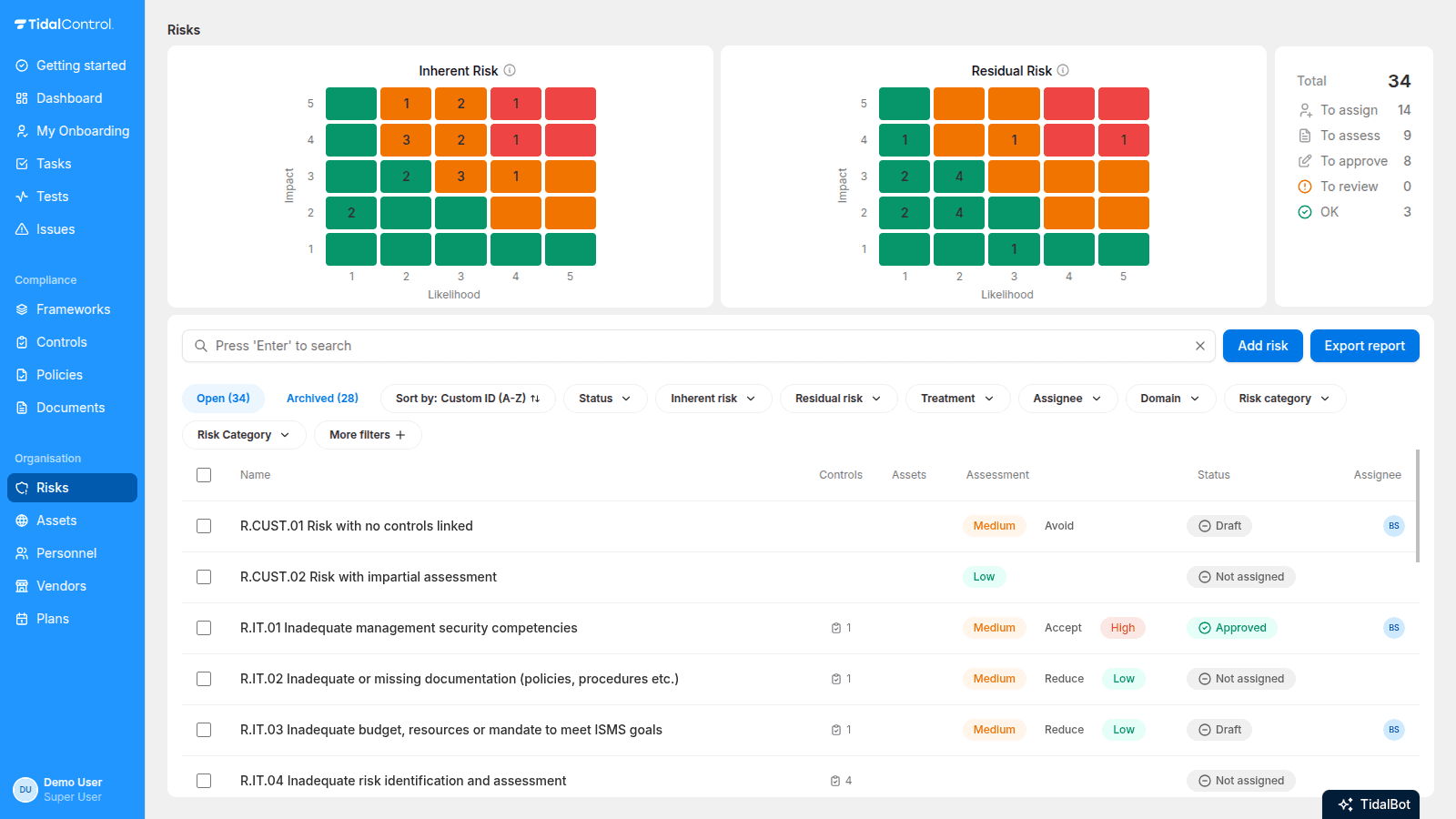
Turn risk assessment from a time-consuming task into a guided process that helps your business grow. Our AI-powered platform learns from your company's context to help assess and manage risks - even if you're new to the process.

Risk assessment in Tidal ControlRisk assessments that work
Controls management

Control management that works your way

Simplify control management with flexible, automation-ready tools that adapt to your needs. Start with our control library or build your own - either way, you'll get powerful automation, clear ownership, and real-time insights.

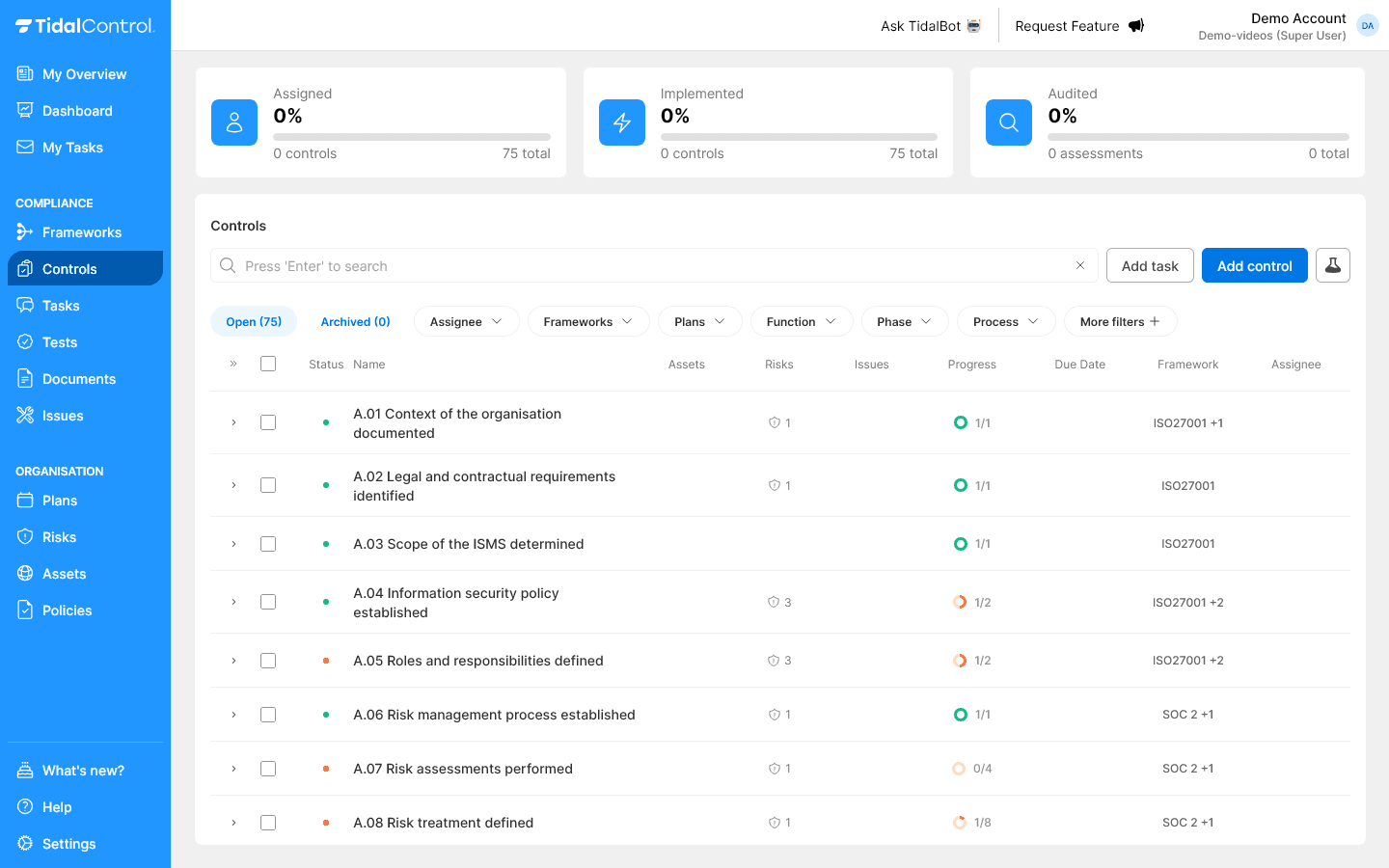
Controls management in Tidal ControlControl management that works your way

Issues management

Vulnerabilities and incidents recorded, ready to report

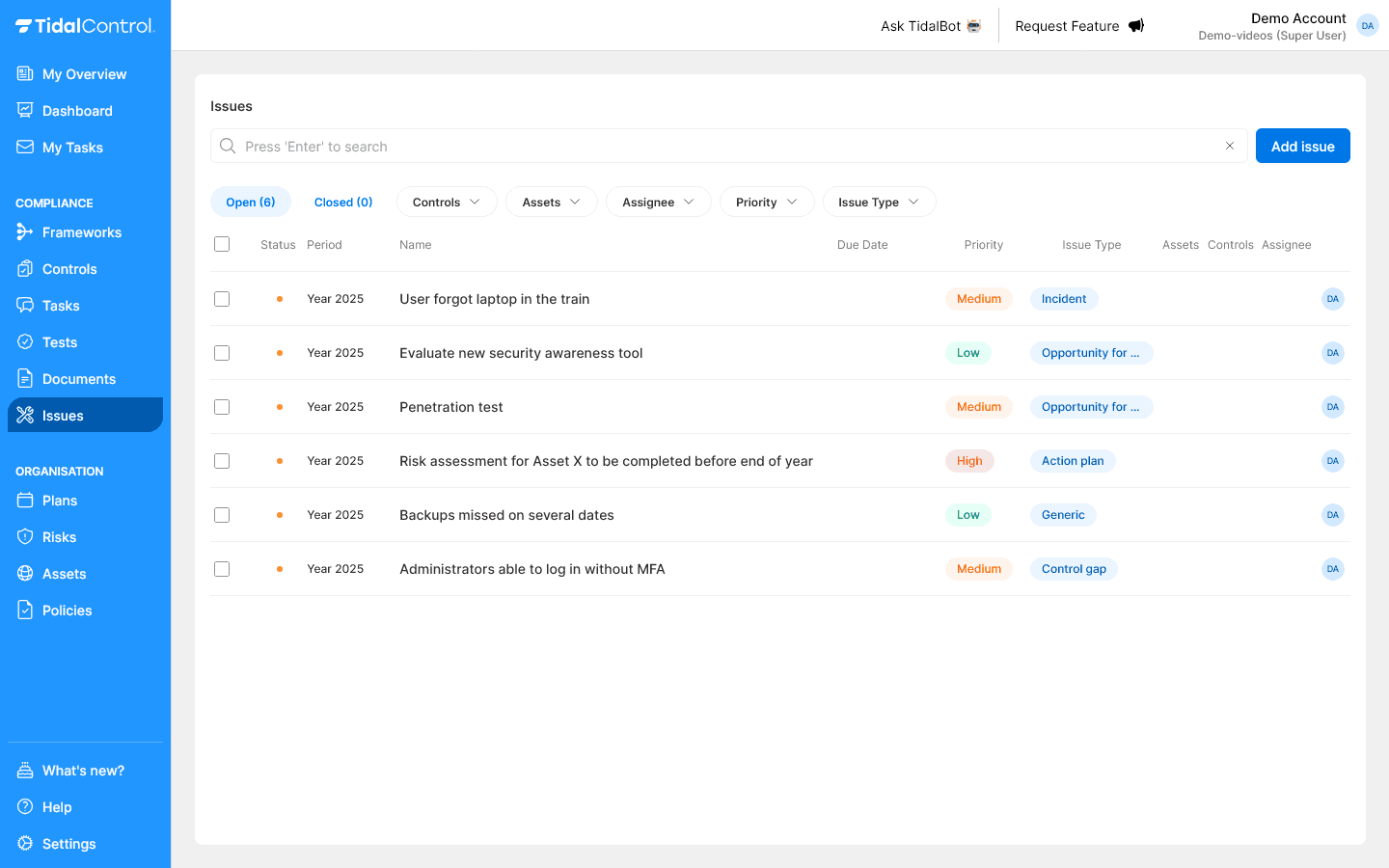
Record vulnerabilities and incidents per product with timeline and handling, so you can report an actively exploited vulnerability on time and with evidence.

Issues management in Tidal ControlVulnerabilities and incidents recorded, ready to report

Vendor management

Supplier risk assessment that actually works

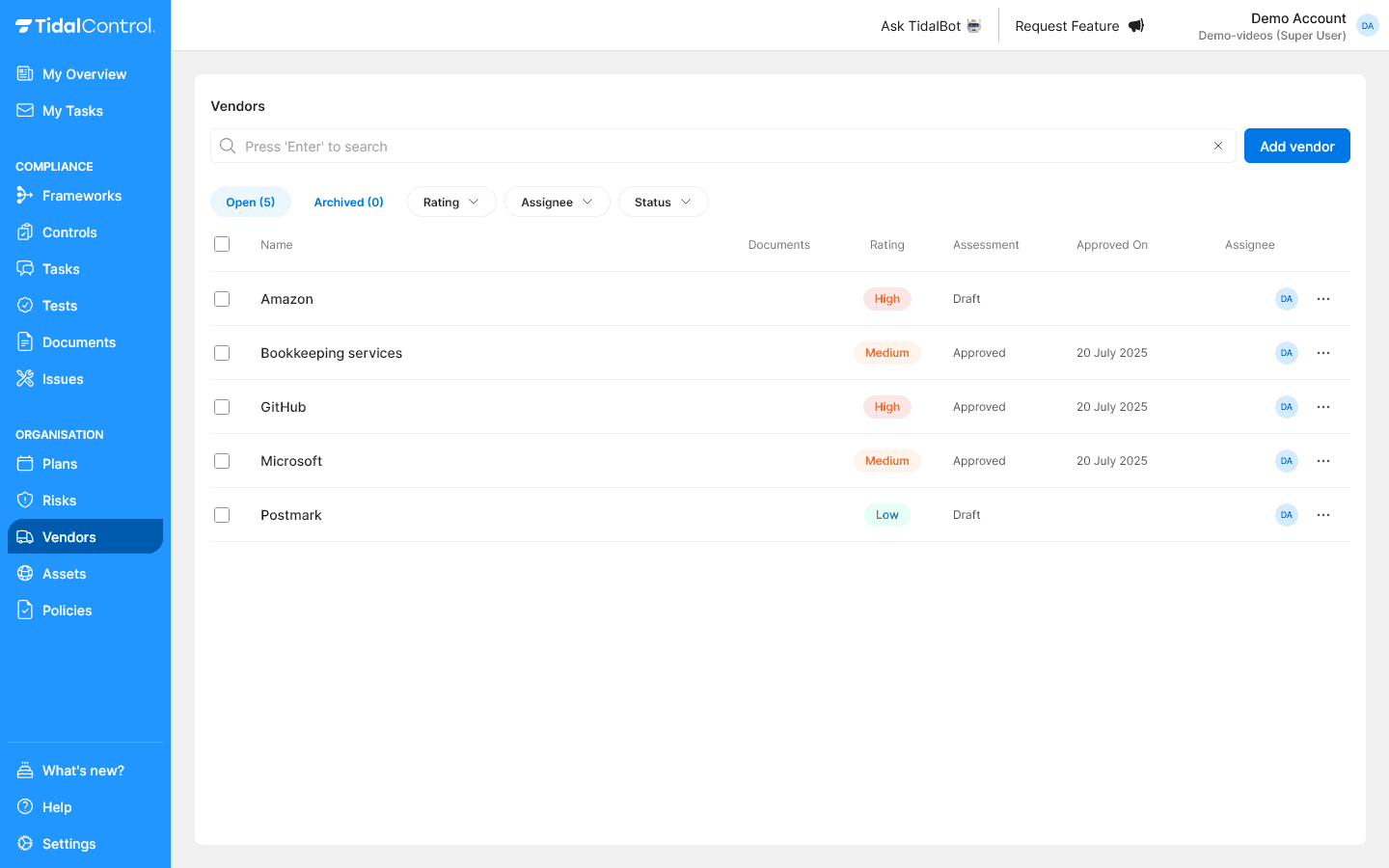
Transform supplier risk assessment from a time-consuming task into an automated process that helps your business grow. Add vendors in seconds with our vendor database that automatically fills in all important details, from privacy policies to SOC2 reports. Our intelligent system then automatically assesses risks and helps you make the right decisions.

Vendor management in Tidal ControlSupplier risk assessment that actually works

Policy center

Policies without the hassle

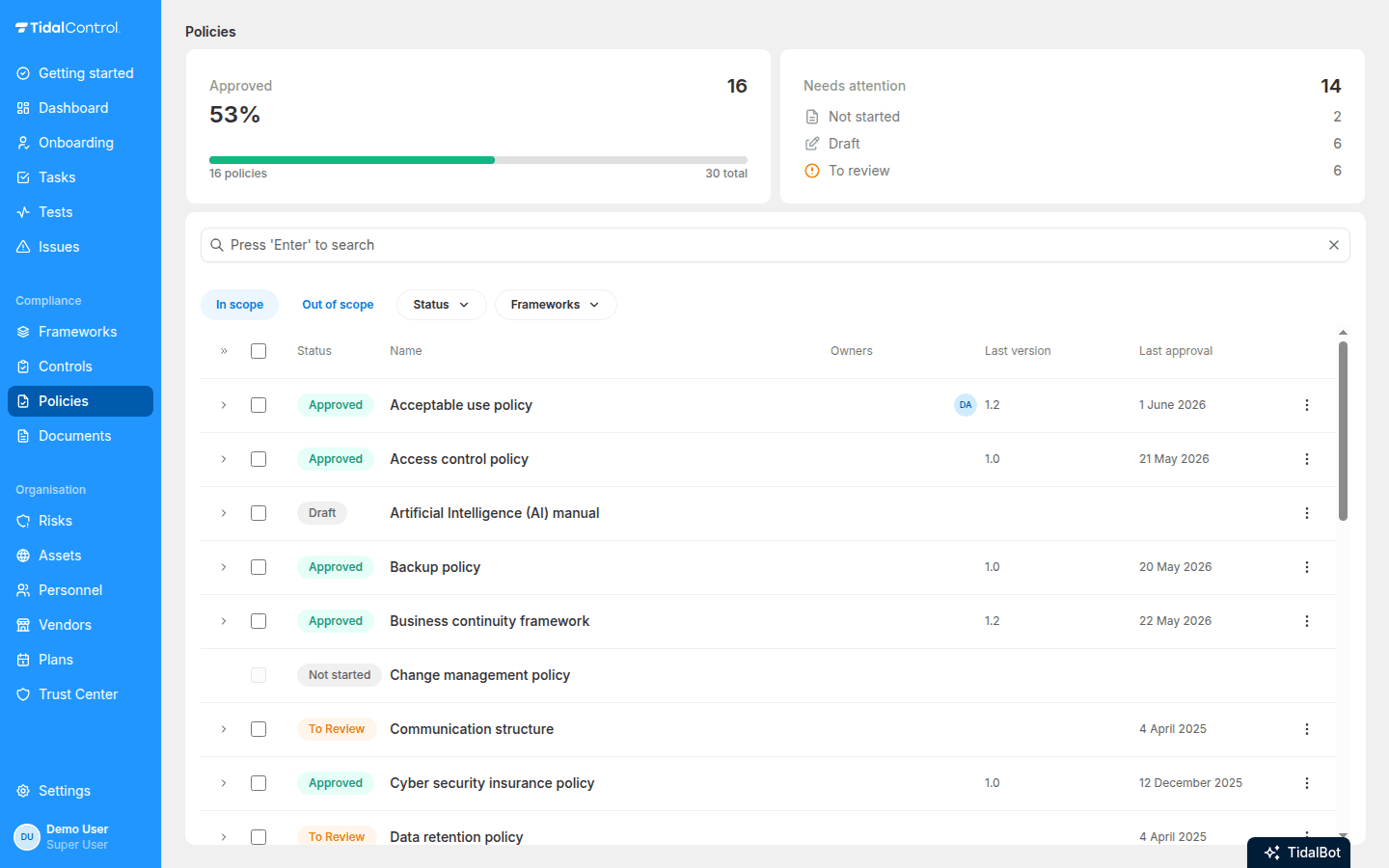
Turn policy management from a complex, time-consuming task into an automated process that grows with your business. Start with our pre-written policies designed for modern companies, or import your existing documents - either way, you'll benefit from smart automation that keeps everything on track.

Policy center in Tidal ControlPolicies without the hassle

Personnel & onboarding

Employee compliance without the spreadsheet

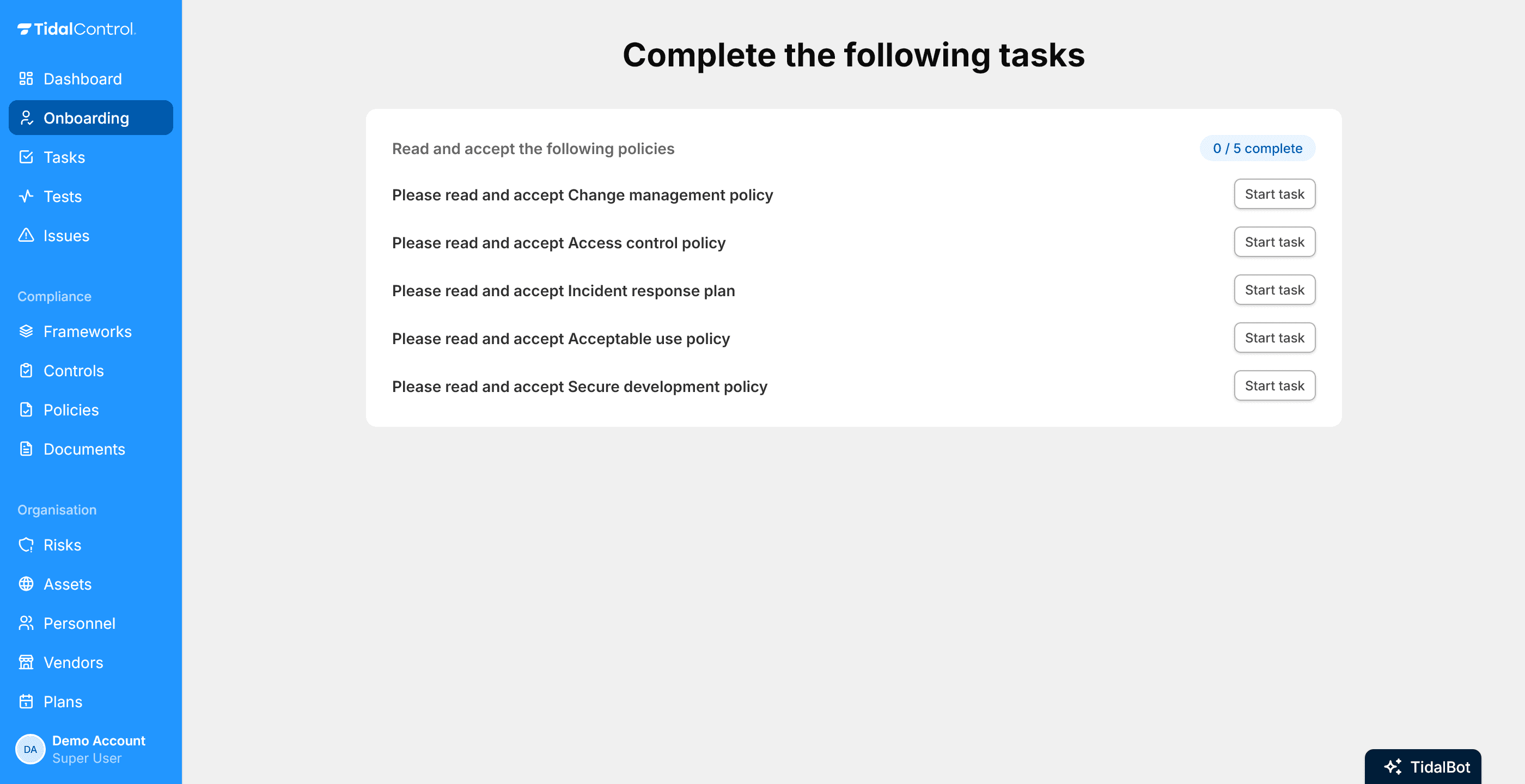
The Personnel module turns employee compliance (onboarding, policy acknowledgements, role assignments) into a self-service flow for your team. No more chasing email confirmations or maintaining a separate spreadsheet of who has accepted which policy.

Personnel & onboarding in Tidal ControlEmployee compliance without the spreadsheet

Integrations

Automation makes life more fun!

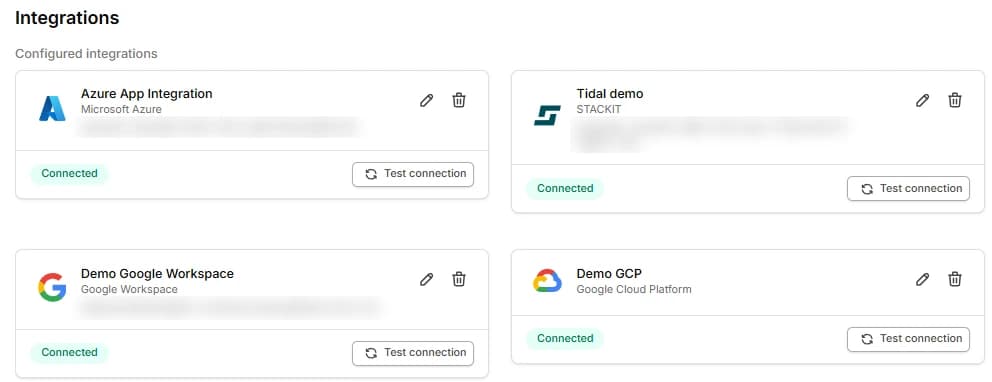
Our integrations collect and evaluate evidence for you, saving you the time of preparing system reports and screenshots every time you need to run a control test.

Integrations in Tidal ControlAutomation makes life more fun!

Manual vs. with Tidal Control

  • CRA requirements

    Manual

    Your own reading of the regulation

    With Tidal

    All 93 requirements pre-mapped

  • Technical documentation

    Manual

    Documents per product scattered

    With Tidal

    Per product in one place

  • Vulnerabilities

    Manual

    Tickets in separate systems

    With Tidal

    Recorded per product, ready to report

  • CRA and IEC 62443

    Manual

    Two projects side by side

    With Tidal

    One set of controls, evidence once

  • Support period

    Manual

    Nobody knows when it ends

    With Tidal

    Recorded per product

Testimonials

What our customers say

With a single click, one Tidal test checks dozens of disks for encryption. Doing that manually would take a lot of time.

Profile picture of Chiel Bos
Chiel Bos
COO·CBYTE
CBYTE logo

See all success stories

Integrate with your existing tools

CRA compliance software for manufacturers

The CRA works per product: per product a risk assessment, technical documentation, a conformity assessment and a support period in which you deliver security updates. With several products, separate documents quickly lose the overview.

CRA compliance software sets up the requirements per product, links them to controls, tests and documents and keeps vulnerabilities and reports current.

Tidal contains the 71 articles of the regulation and the 22 Annex I requirements, 93 in total.

Frequently asked questions

The Cyber Resilience Act (CRA, Regulation (EU) 2024/2847) is an EU regulation that sets cybersecurity requirements for products with digital elements: hardware and software that connect to a device or a network, such as connected devices, desktop and mobile apps, and the components they are built from. It entered into force on 10 December 2024.

The obligation to report actively exploited vulnerabilities and severe incidents applies from 11 September 2026. The other obligations, including the essential cybersecurity requirements, the conformity assessment and the CE marking, apply from 11 December 2027 to products placed on the market from that date.

Manufacturers carry most of the obligations, because they design or have the product designed and place it on the market under their own name. Importers and distributors have their own, lighter obligations, such as checking that a product carries the CE marking and that the manufacturer has met its duties. Software supplied only as a service, without a product, falls outside the CRA, although NIS2 can apply to its provider.

Annex I has two parts. Part I lists the essential cybersecurity requirements for the product itself, such as no known exploitable vulnerabilities at release, a secure default configuration, protection against unauthorised access, data minimisation and the ability to remove data securely. Part II lists the vulnerability handling requirements for the manufacturer, such as a software bill of materials, regular testing, a coordinated vulnerability disclosure policy and security updates for the support period.

The CRA framework in Tidal holds the 71 articles of the regulation, the 14 requirements of Annex I Part I and the 8 vulnerability handling requirements of Annex I Part II, 93 in total. You link each requirement to the controls, tests and documents that meet it, and the platform shows which requirements still have no evidence.

NIS2 is about the security of the organisation and the services it provides, the CRA about the security of the products it places on the market. A manufacturer can fall under both. Secure development, vulnerability management and incident handling count towards both, so Tidal lets you evidence them once.