Frameworks
Cybersecurity that scales with NIST CSF
Scattered security efforts without a unifying structure leave critical gaps that attackers exploit.
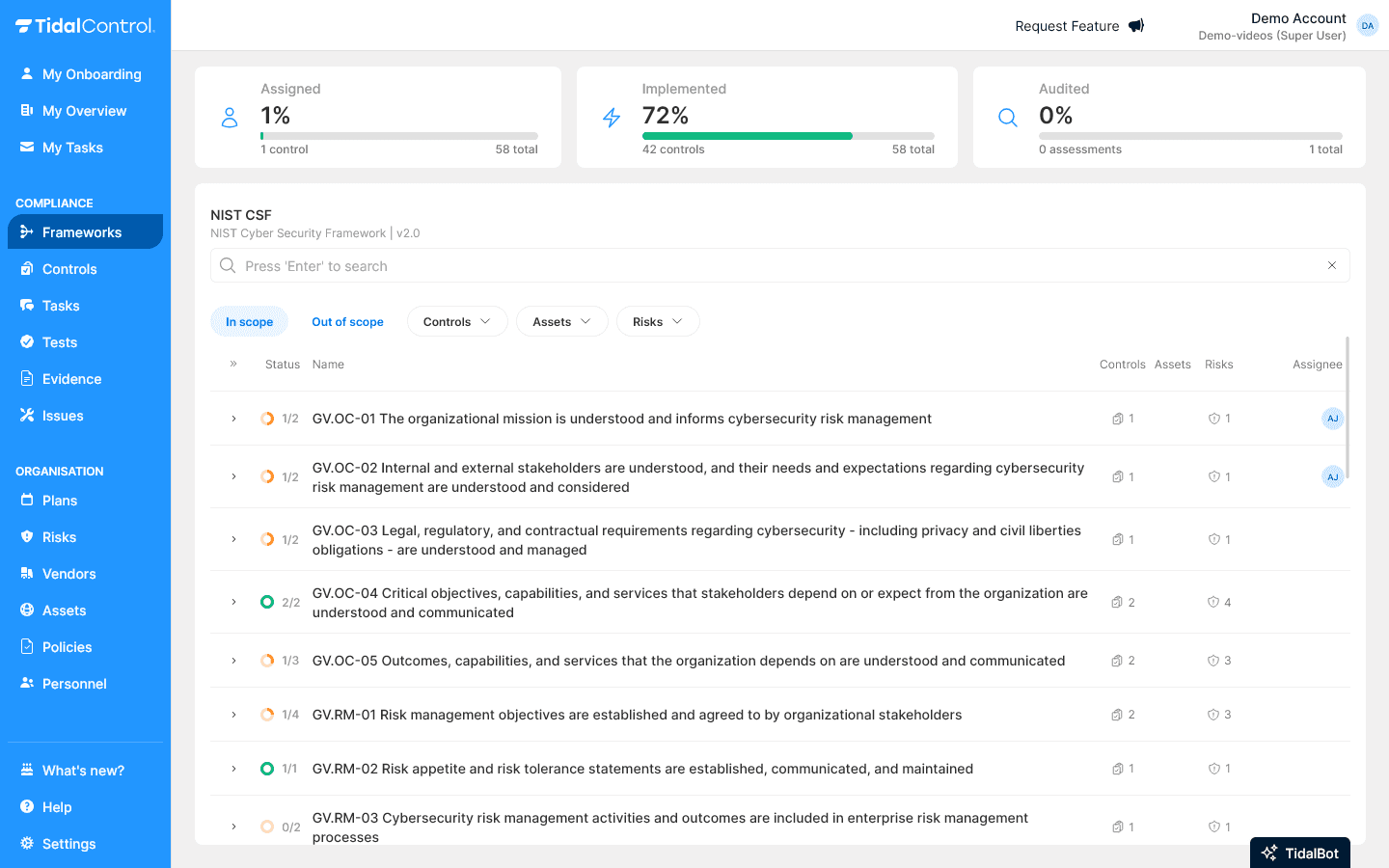
Tidal brings structure to your cybersecurity programme. Implement all six functions of the NIST CSF, prioritise risks systematically, and mature your cybersecurity capabilities with proven framework.
These companies run their compliance on Tidal Control















NIST CSF in depth
The NIST Cybersecurity Framework is developed by the National Institute of Standards and Technology and offers organisations a structured way to identify, manage, and communicate cyber risks. The framework is designed to be understandable for both technical teams and management.
In practice, NIST CSF is often used as a reference, but not structurally applied. This keeps the framework abstract and makes it difficult to translate cyber risks into concrete actions and decision-making.
By applying NIST CSF as a strategic framework, a common language emerges. Cybersecurity becomes manageable and discussable at organisational level instead of a purely technical domain.
How Tidal helps you get certified
Hit the ground running
Start with our pre-built controls, policies, and risk assessment templates.
Our platform guides you through establishing your ISMS scope, identifying assets, and implementing right-sized controls that match your business needs.

Why Tidal Control
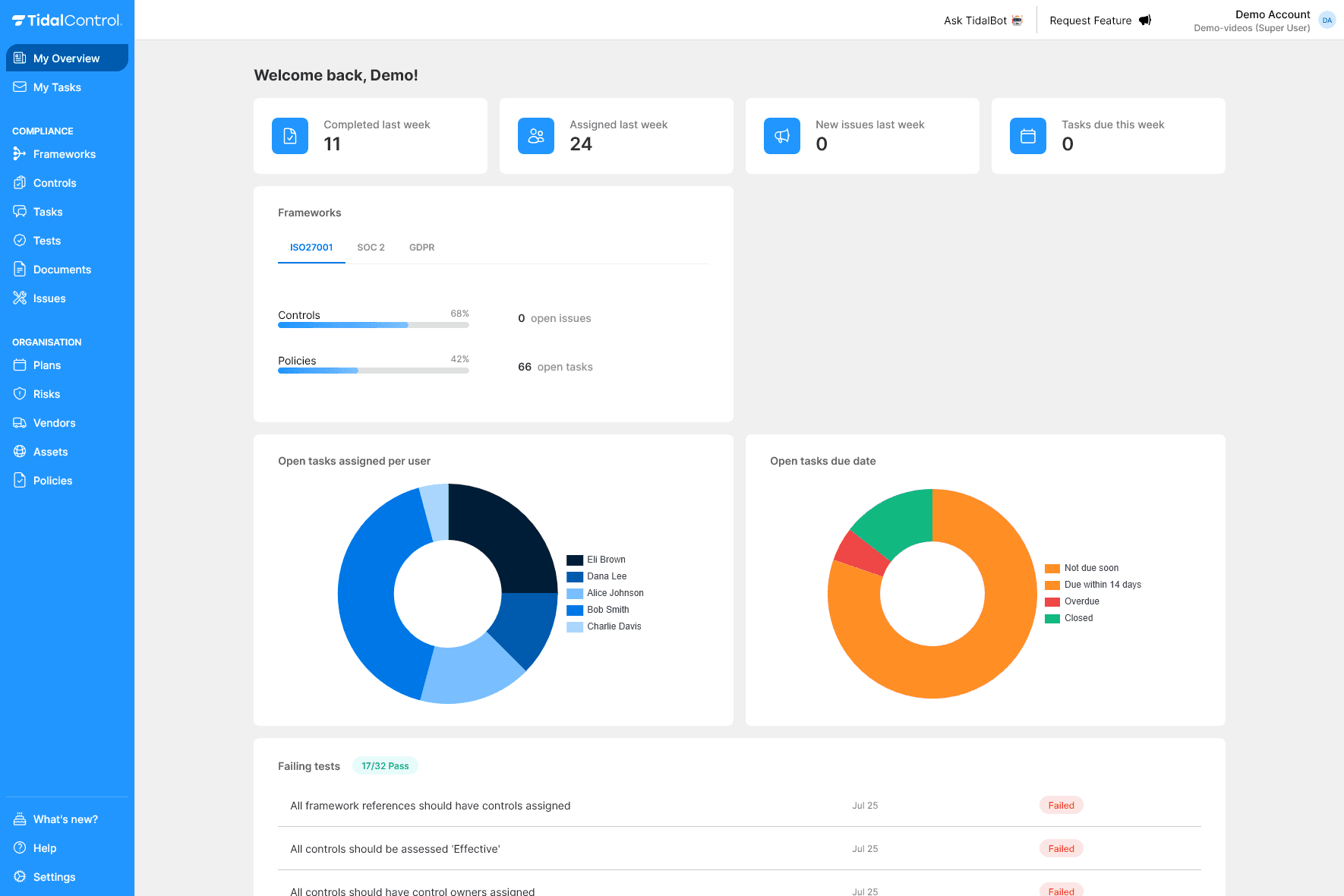
We understand your challenges because we've been there. Our team of GRC experts and security professionals built Tidal to solve the real problems compliance teams face every day.
Made in Europe
Built and hosted in Europe. Your compliance data stays in the EU for full control and peace of mind.
Continuous automation
Automated evidence collection from cloud providers and development tools working 24/7 for you.
Real security
Build secure systems that protect your business and satisfy auditors, not just check compliance boxes.
Go beyond NIST CSF
Explore complementary frameworks that strengthen your cybersecurity risk management.
ISO 27001
Building certified information security? ISO 27001 provides a complementary framework with similar risk management approach and international recognition.
NIST SP 800-53
Implementing detailed federal controls? NIST SP 800-53 provides specific security controls that operationalise NIST CSF's framework.
CIS Controls
Prioritising security actions? CIS Controls provide prioritised security safeguards that align with NIST CSF's Protect function.
DORA
Building digital operational resilience? DORA applies NIST CSF principles specifically to financial entity resilience requirements.
Integrate with your existing tools


































Testimonials
What our customers say
With a single click, one Tidal test checks dozens of disks for encryption. Doing that manually would take a lot of time.


Frequently asked questions
The NIST CSF is a voluntary framework developed by the US National Institute of Standards and Technology. It provides a structured approach to managing cybersecurity risk, widely adopted across sectors and geographies for its practical, outcome-focused approach.
NIST CSF is voluntary for most organisations. However, it's increasingly referenced in regulations, contracts, and industry standards. Many organisations adopt it because it provides a recognised, approach to cybersecurity risk management.
Yes, NIST CSF is designed to complement other frameworks. Our platform helps you map controls between NIST CSF and standards like ISO 27001, avoiding duplication whilst leveraging the strengths of each framework.
NIST CSF is a high-level framework focused on outcomes and risk management. NIST 800-53 provides detailed security controls, often required for US federal systems. Our platform supports both, helping you implement appropriate controls based on your requirements.
Our platform is updated for NIST CSF 2.0, including the new Govern function and updated categories. We provide current guidance, controls, and implementation support aligned with the latest version of the framework.
Yes, many insurers recognise NIST CSF implementation as evidence of cybersecurity maturity. Our platform helps you demonstrate the controls and practices that insurers look for, potentially improving your coverage and premiums.